Market Trends
The AI Infrastructure Race Is No Longer About Chips. It Is About Who Energizes Megawatts First.

Founder of UFD · CEO of Think Loud Studios · Professional Race Car Driver
Published · 6 min read
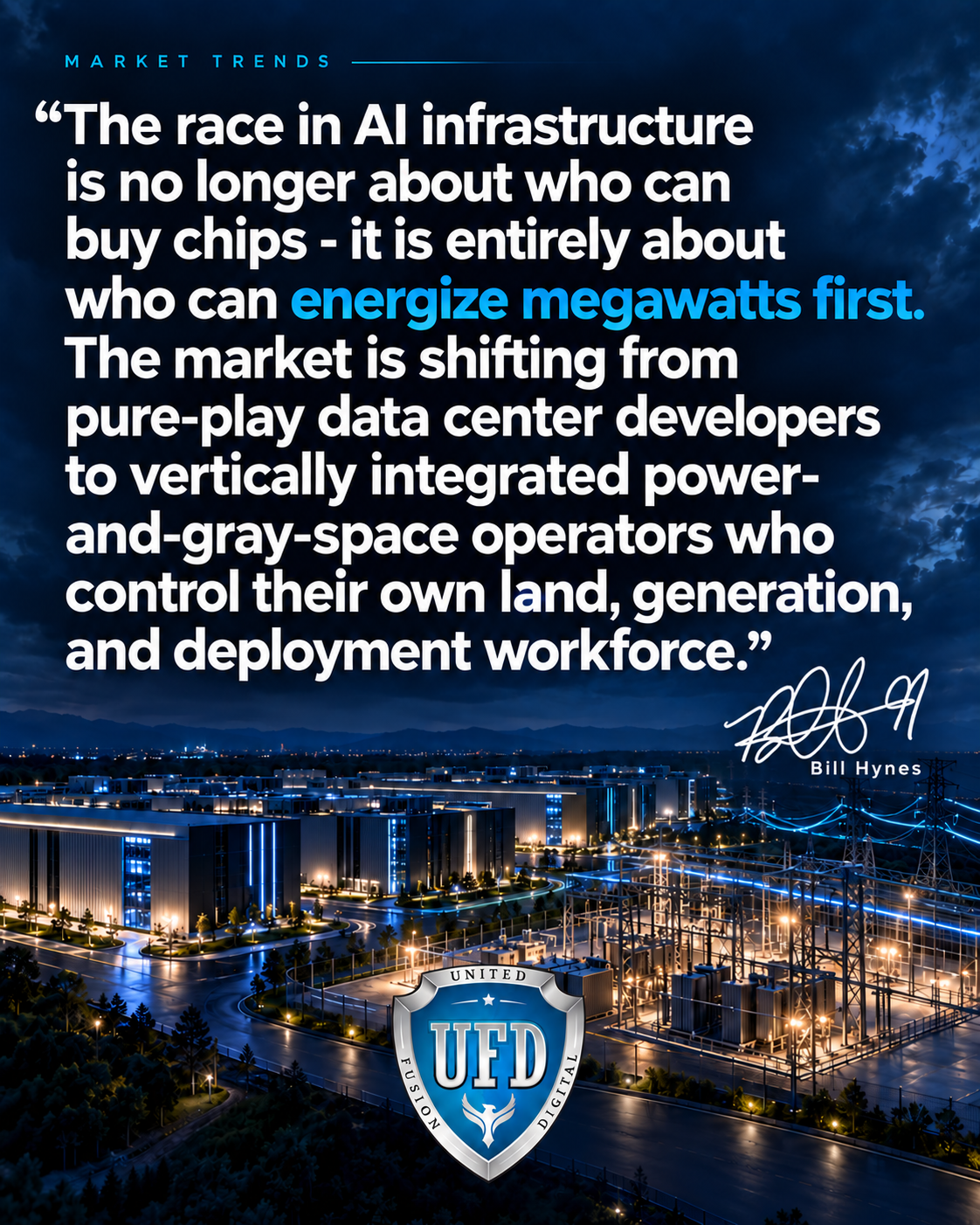
“The race in AI infrastructure is no longer about who can buy chips, it is entirely about who can energize megawatts first. The market is shifting from pure-play data center developers to vertically integrated power-and-gray-space operators who control their own land, generation, and deployment workforce.”
For the last few years, the AI story has been told as a chip story. Who got the GPUs. Who got the allocation. Who signed the biggest order.
That story is over.
Chips will always be there. The chip market has shown it can figure out supply and demand. Shortages get solved, factories get built, allocation catches up.
Chips can be bought. Capital can be raised. What cannot be bought on a short timeline is energized power on land that is ready to build, with a crew ready to deploy. That is where the AI infrastructure race is being decided now, and it is why the winners of the next decade will look very different from the winners of the last one.
The bottleneck moved
A GPU sitting in a warehouse earns nothing. It only becomes valuable when it is racked, cooled, and drawing power. Across the industry, the gating item is no longer the hardware order. It is the date the power turns on.
That changes the question every AI company, hyperscaler, and investor should be asking. Not "can you get chips?" but "when can you energize megawatts, and can you prove it?"
The companies that can answer that question with a real date, on real land, with real power behind it, are the ones that will capture the demand.
Why the pure-play developer model is under pressure
The traditional data center developer model splits the job into pieces. One party finds the land. Another negotiates for power. Another designs the building. Contractors build it. A separate team deploys the equipment. Every handoff adds time, cost, and risk.
That model worked when power was easy to get and timelines were measured in years. It struggles when the market is moving in months and every delay is lost revenue for the customer.
The market is shifting to operators who own the whole chain. That is what I mean by vertically integrated power-and-gray-space operators.
The three things that win the race
1. Land
Control of the site is the starting line. Not an option on a parcel. Not a letter of intent. Control. If you do not control the land, you do not control the schedule, and if you do not control the schedule, you cannot make a credible promise to a customer.
2. Generation
Power is the new scarcity. Operators who can bring their own generation, or who have secured power they can actually deliver, move to the front of the line. Gray space, meaning the power, cooling, and electrical infrastructure that sits behind the white space where servers live, is where the real value is being created. The building is the easy part. Energized gray space is the hard part.
3. Deployment workforce
This is the piece most people overlook. Having land and power on paper means nothing without the people who can execute: electricians, technicians, project managers, and deployment crews who know how to stand up AI infrastructure fast and safely. A team that has done it before is worth more than any spreadsheet.
Land, generation, and workforce. You need all three under one roof. Miss one and the whole timeline slips.
The irony of the AI workforce
Here is the part of this story that does not get talked about enough. It takes great people to build the sites that run AI, and AI will eliminate some jobs.
Both things are true. AI will automate some work that people do today. But the buildout itself is creating real demand for skilled people: electricians, power engineers, technicians, project managers, and deployment crews. Those are jobs that cannot be automated away, because someone has to physically stand up the power and the infrastructure.
The companies that recruit, train, and keep those people will have an advantage that is very hard to copy. In this race, the workforce is not a line item. It is a moat.
How UFD is built for this
United Fusion Digital was built around this exact thesis.
Our first site, Site 1, was designed from day one as our reference design: a containerized, power-first approach to AI infrastructure. The goal is simple. Prove the model once, then repeat it. Standardize the design, control the inputs, and shorten the time between "we have a customer" and "the power is on."
We are not trying to be the biggest name in data centers. We are focused on being the team that energizes megawatts first.
What this means for AI companies and investors
If you are building or funding AI, here is the practical takeaway:
- Ask for the energization date, not the square footage. Space is not the constraint. Power is.
- Ask who controls the land and the power. If the answer involves several outside parties, add time and risk.
- Ask who does the deployment. An operator with its own workforce can move faster than one waiting on contractors.
- Favor repeatable designs. A proven reference design is faster and less risky than a custom build every time.
The bottom line
The AI infrastructure race has a new finish line. It is not who bought the most chips. It is who turned the power on first.
The operators who control their own land, their own generation, and their own deployment workforce will set the pace for everyone else. That is the company we are building at UFD.
Building AI capacity and need power? Talk to UFD.