Insights
Why Fiber Infrastructure Still Matters in the AI Era

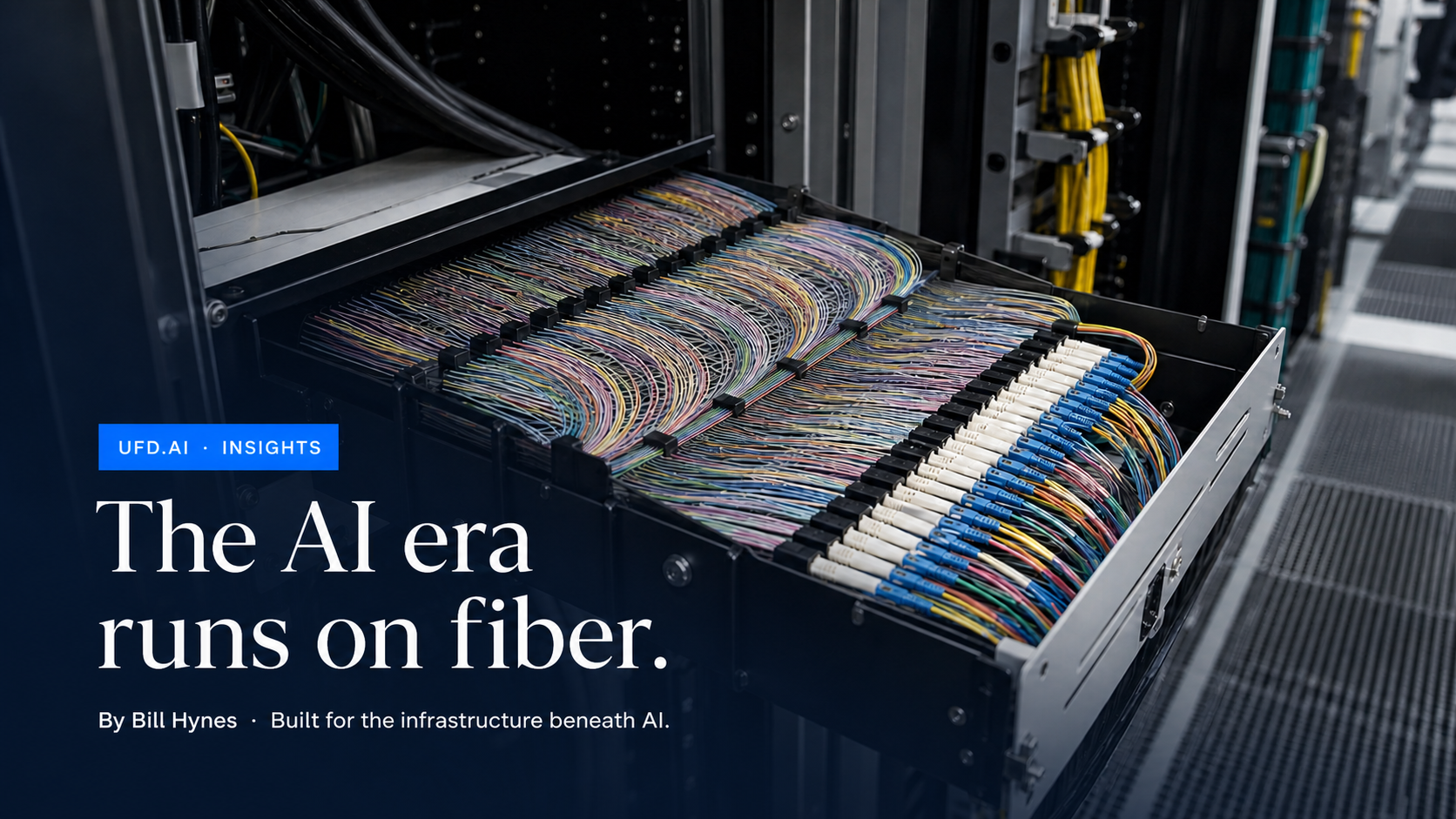
Everyone is talking about AI. The chips, the models, the funding rounds. Billions of dollars are moving into compute. But almost nobody is talking about what sits underneath all of it.
AI runs on GPUs. GPUs run on data centers. Data centers run on fiber, power, cooling, and the physical infrastructure that most people never think about. Without that foundation, none of it works. Your model does not train. Your data does not move. Your application does not reach a single user.
I have spent years building that foundation. And what I see right now is an industry repeating mistakes that the infrastructure world solved a long time ago.
The Corridor
After the first World Trade Center bombing, the telecommunications industry talked seriously about building data backup capacity in Pennsylvania. Some called it Wall Street West. The idea was geographic diversity: if something happened to the financial infrastructure in lower Manhattan, there needed to be a separate, resilient pathway for data.
That vision never materialized.
When we founded UFD, it was to build exactly that. A geographically diverse fiber pathway between the financial epicenter of the world and the data center capital of the world. New York to Northern Virginia. That was Phase 1. Phase 2 would have extended diverse paths to Charlotte and Atlanta.
The customers we were building for were not small businesses. We were targeting hyperscalers like Apple, Google, Facebook, and Amazon. Carriers like AT&T, Verizon, and T-Mobile. Financial institutions. Financial exchanges. Other fiber providers. All of them would benefit from true network diversity, and most of them still do not have it.
That infrastructure thesis has not changed. If anything, the AI era has made it more urgent.
Build to the Ceiling, Not the Floor
The biggest mistake I see in infrastructure right now is that people build to the floor, not the ceiling.
Here is what that means. A company evaluates their fiber needs and decides they need 864 strands. They engineer for 864 strands. They install 864 strands. And within a few years, they are out of capacity and tearing up the ground again.
The reality is that 1,728 strands might be the floor. They should be looking at 3,456. The cost difference between installing 864 strands and 3,456 strands during initial construction is a fraction of what it costs to go back and do it later. But people plan for today instead of building for tomorrow.
This applies to everything in infrastructure. Conduit. Power capacity. Cooling. Space. If you are going to dig the trench, run the conduit, pull the permits, and shut down traffic, build it right the first time. Overbuild. The demand will catch up to you faster than you think.
The AI compute buildout is proving this in real time. Data centers that were designed five years ago are already running out of power and connectivity. They built to the floor.
The Real Challenge
People assume the hardest part of infrastructure is the physical work. Permits, right-of-way, construction, weather, municipalities. That is all hard. But it is not the hardest part.
The hardest part is people.
Building the right team with the right vision is more difficult than putting fiber in the ground. In infrastructure, the margin for error on leadership is razor thin. One executive who cannot see where the market is heading, one hire who is faking expertise, one team that is stuck in the old way of doing things, and it costs you years. The infrastructure itself is straightforward if you know what you are doing. Getting the right people to execute it is where most projects succeed or fail.
The construction was the easy part. That is a lesson I carry into everything I build now.
The Bottleneck Nobody Talks About
The AI industry talks about chip shortages, model training costs, and talent wars. Those are real constraints. But the bottleneck that will slow everything down is power.
Electric utilities are not built for the energy demand that AI compute requires. Permitting new power infrastructure takes years. Utilities are already struggling to keep up with current demand, and the AI buildout is just getting started. Data centers are being delayed or downsized not because of chip supply or real estate, but because there is not enough power available.
Bombe is building to solve exactly that. We mitigate the power bottleneck with a diversified energy approach: solar, generator sets, and hydrogen. Not because grid power is going away, but because waiting for utilities to catch up is not a strategy. The companies that build their own power resilience will be the ones that actually deliver compute at scale.
Think of Bombe as the conductor of the orchestra. Fiber, power, cooling, compute, connectivity. Each one is an instrument. The experience from building fiber and data center infrastructure is knowing how all of those parts fit together. That does not come from a textbook. It comes from having done it.
What People Do Not Understand
There is a growing movement of people protesting data centers and AI infrastructure. They see the construction, the power draw, the land use, and they push back. I understand the concern. But most of the opposition comes from not fully understanding what these facilities actually do.
AI-powered medical imaging can read an X-ray or MRI faster and more accurately than a human, leading to fewer diagnostic mistakes and faster treatment. That saves lives. The photos and videos on your phone, your memories, they are stored in data centers. Almost everyone has a phone. Almost everyone benefits from the infrastructure they are protesting.
This is not abstract technology. It is the foundation that modern life runs on.
We Finish What We Start
The fiber corridor between New York and Northern Virginia. The infrastructure thesis that was ahead of the market. The companies that needed true network diversity and still do not have it. That work is not finished.
UFD represents something simple. We finish what we start.
The AI era did not change the infrastructure problem. It magnified it. More data, more compute, more demand, and the same physical constraints that have always existed: fiber in the ground, power to the building, cooling to the rack. The companies that understand this, the ones that have actually built it, are the ones that will build it again.
This time it will be different.